
chemistry 260: Chemical principles
This course is an advanced look at the general principles that underlie chemistry intended for second and third-year undergraduates in chemistry and related fields. The course presents the first exposure to the ideas of quantum mechanics, attempting to build up a picture of chemistry based on this important 20th century perspective. Following the quantum chemistry development, we take a step back and introduce the fundamental concepts of thermodynamics. Here we build to the powerful concepts of free energy and spontaneity by progressing through the three laws of thermodynamics. Examples and applications of free energy include chemical equilibrium, phase transitions, electrochemistry, and acid-base chemistry. Finally, realizing that thermodynamics is not the whole story, we cover chemical kinetics and the rates of chemical reactions. Throughout we attempt to draw connections between the different areas, while maintaining a "molecular" viewpoint. Topics introduced in this course are expanded upon and are covered in more depth in later chemistry courses. The goal here is to provide the conceptual landscape, thus enabling chemical understanding based on only a small set of fundamental principles.
chemistry 453: Biophysical chemistry 1: Thermodynamics and kinetics
How do proteins fold spontaneously into the precise 3D structure needed to perform their function? How do organisms synthesize molecules when energy input is required? Why do we get sick when our temperature increases by only a few degrees? In this advanced undergraduate course in the fundamental physical foundations of biochemistry, we will develop theories and models that help us predict and understand chemical phenomena, with a focus on the remarkable molecules and reactions of biochemistry. In principle, there is no reason we need to separate this course from our usual physical chemistry sequence, but given central role of macromolecular structure and reactivity, we need to pay particular attention to the statistical nature of chemistry of biological systems.
CHemistry 462: Computational Chemistry lab
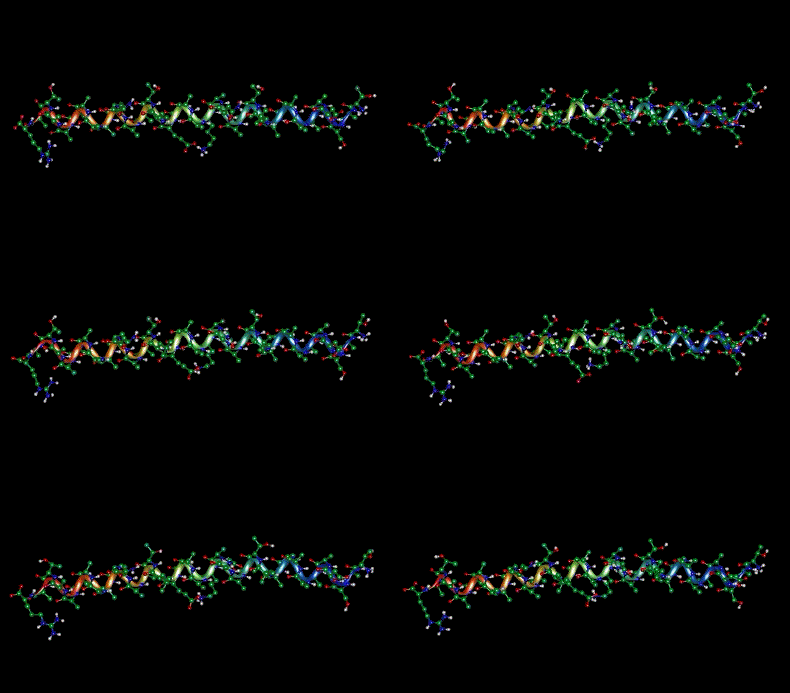
short MD simulation of an anti-freeze protein
Chemistry 462 is a computational chemistry course for upper level undergraduates. This is a physical chemistry laboratory that aims to take the lid off of otherwise black-box numerical methods central to chemistry. Since computational tools are used in every discipline of chemistry, it is important to understand the capabilities and limitations of popular computational approaches–many of which are available in convenient and easy-to-use packages.
One of the overarching principles of the course will be "garbage-in-garbage-out". That is, the computer will always give the right answer to whatever question it is asked. The key is to ask the right question.
The animation above is of a molecular dynamics trajectory for an antifreeze protein in water (the water is not shown). Students repeat the simulation at different temperatures and simulate a melting curve.
chemistry 580: Molecular Spectra and Structure
Spectroscopy is a wide-ranging topic that is essential in chemistry. Indeed, there are other courses in the chemistry department—even at the graduate level—on “spectroscopy.” For example, organic chemists take Chem 542 “Applications of Physical Methods to Organic Chemistry”, inorganic students take Chem 616 “Advanced Inorganic Chemistry,” and analytical students take Chem 648 “Analytical Spectroscopy and Imaging.” All of these courses deal heavily with spectroscopy.
What is special/different about Chem 580? In contrast to the spectroscopy-as-a-tool courses, Chem 580 explores the rigorous origin of why spectroscopy occurs, and develops a framework from the very first principles rooted in quantum mechanics. This course is essentially a second semester of graduate quantum mechanics, with a focus on spectroscopy. We will start with the most basic systems that can interact with light (a two-level system), and build up exact formulations as well as approximations based on time-dependent perturbation theory. We will derive major results, but we will also work on modeling interesting molecular phenomena that permeate modern chemistry.
Due to the COVID pandemic, this course is fully remote, with the lecture segments all available on YouTube on Prof. Kubarych’s channel.